Strategic Legal Solutions For A Global Business World
Strategic Legal Services Tailored for Modern Business — advisory and dispute resolution across intellectual property, media, technology, corporate and regulatory law, delivered by dedicated practice groups from Istanbul for clients around the world.
A Proven Legal Blueprint to Secure What You've Built.
Devin Law & IP is a boutique law firm with over 15 years of combined experience from its founders and partners. The firm operates on principles of transparency, integrity, and shared values, and delivers sustainable legal solutions through dedicated practice groups.
We serve diverse international clients by forming specialized teams with sector expertise. Long-term client relationships, diversity, continuous education and professional development are our core institutional values.
Founded on professionalism, transparency and long-term value creation, the firm combines sector expertise with strategic legal insight — providing clear, practical and result-oriented solutions for businesses and individuals.
Alongside its Istanbul headquarters, the firm manages trademark and patent portfolios across multiple jurisdictions through its attorneyship practice — handling filings, oppositions, renewals and enforcement before TÜRKPATENT, EUIPO and WIPO on behalf of local and international rights holders.
This dual structure — Legal Services on one side and Trademark / Patent Attorneyship Services on the other — allows the firm to combine contentious litigation strength with disciplined portfolio administration, so that every matter is handled by a team specialised in its own field.
02
Why Choose Us
Legal Expertise
Professionals with extensive knowledge across industries provide strategic advice and actionable insights. Every matter is staffed by a team with genuine sector experience, so our advice reflects commercial reality rather than abstract theory.
Client-Focused Approach
Personalized solutions tailored to specific client goals through collaborative engagement. We invest time in understanding each client's business model, risk appetite and priorities before shaping the legal strategy around them.
Innovative Legal Solutions
Leveraging modern legal technologies to develop creative, sustainable approaches. From portfolio automation to structured watch services, we use technology to deliver faster and more consistent outcomes.
Commitment to Sustainability
Supporting clients in adopting ethical practices that benefit both business and society. We help build compliance cultures that are durable, defensible and aligned with evolving international standards.
Strategic Perspective
Aligning legal solutions with business objectives for sustainable growth. Advice is always framed as a business decision — with clear options, realistic costs and measurable consequences.
03
Legal Services Tailored to Your Business
01
Industrial Property Law
Trademarks, patents & utility models and industrial designs — consultancy, prosecution and litigation before TÜRKPATENT, EUIPO and WIPO.
Explore →
02
Intellectual Property & Copyright Law
Copyright, software and related rights under FSEK No. 5846 — from ownership architecture and registration through to piracy enforcement.
Explore →
03
Media, Entertainment & Advertisement
Where creative expression meets complex regulation — advertising review, broadcasting compliance, production and talent agreements.
Explore →
04
Data Protection, Privacy & Cybersecurity
Defensible governance under KVKK and the GDPR — data mapping, cross-border transfers, breach response and defence before the Authority.
Explore →
05
IT & Technology Law
Software, SaaS and cloud contracts, gaming and e-sports, startup financing rounds, e-commerce and fintech regulation, and the legal architecture around artificial intelligence.
Explore →
06
Corporate Law & Commercial Advisory
Retainer counsel across every department, commercial contracts, general assemblies, board resolutions, capital structures and shareholder disputes.
Explore →
07
Dispute Resolution & Litigation
Commercial and contractual litigation, debt recovery and enforcement, labour defence, white-collar crime, shareholder disputes, lease actions, mediation and arbitration.
Explore →
08
Maritime, Yachting & Shipyard Law
Superyacht newbuilds and refits, shipyard operations, yacht design and IP, sale and purchase, flagging, chartering and crew, vessel arrests and marine casualties.
Explore →
"From the first spark of creativity to the global protection of your brand."
Ranked in five practice categories in Türkiye — Uğurcan Tekin & İnci Özçilsal recognised as Rising Stars.
Recommended · 2026WTR 1000
Uğurcan Tekin recognised individually for trademark protection and international IP strategies.
Ranked · EMEA 2026The Legal 500 EMEA
Uğurcan Tekin — Next Generation Partner for Intellectual Property and Media & Entertainment.
Tier 2 · 2026Media Law International
Uğurcan Tekin — Top 10 Recommended Media Lawyers in Turkey.
Also ranked by the same directories in their 2025 editions — The Legal 500 EMEA, Media Law International, IP STARS and the WTR 1000.
05
Our Team
Uğurcan Tekin, LL.MPartner / Attorney at Law — Trademark Attorney
Alican Tekin, LL.MPartner — Trademark Attorney
Kadir Karasu, MBAPartner
Tevrat TekinCounsel / Attorney at Law
İnci ÖzçilsalAttorney at Law
Beyza ErdemirAttorney at Law
Şevval Ezgi DemirAttorney at Law
Mehmet Kerem KüçükTrademark & Patent Specialist
Berkay KizenFinance Specialist
Aleyna KalburcuLegal Trainee
Sıla UçarLegal Trainee
Uğurcan Tekin, LL.MPartner / Attorney at Law — Trademark Attorney
Alican Tekin, LL.MPartner — Trademark Attorney
Kadir Karasu, MBAPartner
Tevrat TekinCounsel / Attorney at Law
İnci ÖzçilsalAttorney at Law
Beyza ErdemirAttorney at Law
Şevval Ezgi DemirAttorney at Law
Mehmet Kerem KüçükTrademark & Patent Specialist
Berkay KizenFinance Specialist
Aleyna KalburcuLegal Trainee
Sıla UçarLegal Trainee
06
Insights
Maritime & IP
Undeclared Goods on Board: Conviction and Acquittal Criteria in Smuggling Cases
9 October 2026 — Read →
Media & Advertising
Advertising Board Decisions — Meeting No. 372: 5G Superiority Claims, Consumer Reviews and Blocking of Access to Review-Selling Websites
5 October 2026 — Read →
Data Protection
Turkish Data Protection Board Decisions — October 2026: Form of Response to Data Subject Applications and the Breach Notifications of 30 September 2026
5 October 2026 — Read →
Regulatory
Official Gazette Weekly Update — 28 September–4 October 2026: Annulment of the Phrase “Indefinitely” in Poverty Alimony, Real Estate Trade and the Distilled Spirit Drinks Communiqué
5 October 2026 — Read →
Trademark
Acquiescence in Trade Mark Law: Different Rules for Invalidity and Infringement
5 October 2026 — Read →
Data Protection
Lawyers' Data Protection Obligations and Breaches at Data Processors
28 September 2026 — Read →
Competition
Competition Law Developments in Türkiye: September 2026
28 September 2026 — Read →
Maritime & IP
Collision in the Sea of Marmara: Civil and Criminal Liability in Maritime Casualties
15 September 2026 — Read →
Media & Advertising
Advertising Board Decisions — Meeting No. 366: Platform Liability, Trademark Use and Price Transparency
5 September 2026 — Read →
Media & Advertising
Advertising Board Decisions — Meeting No. 367: Right of Withdrawal, Comparative Claims and Health Connotations in Product Names
5 September 2026 — Read →
Maritime & IP
Undeclared Goods on Board: Conviction and Acquittal Criteria in Smuggling Cases
9 October 2026 — Read →
Media & Advertising
Advertising Board Decisions — Meeting No. 372: 5G Superiority Claims, Consumer Reviews and Blocking of Access to Review-Selling Websites
5 October 2026 — Read →
Data Protection
Turkish Data Protection Board Decisions — October 2026: Form of Response to Data Subject Applications and the Breach Notifications of 30 September 2026
5 October 2026 — Read →
Regulatory
Official Gazette Weekly Update — 28 September–4 October 2026: Annulment of the Phrase “Indefinitely” in Poverty Alimony, Real Estate Trade and the Distilled Spirit Drinks Communiqué
5 October 2026 — Read →
Trademark
Acquiescence in Trade Mark Law: Different Rules for Invalidity and Infringement
5 October 2026 — Read →
Data Protection
Lawyers' Data Protection Obligations and Breaches at Data Processors
28 September 2026 — Read →
Competition
Competition Law Developments in Türkiye: September 2026
28 September 2026 — Read →
Maritime & IP
Collision in the Sea of Marmara: Civil and Criminal Liability in Maritime Casualties
15 September 2026 — Read →
Media & Advertising
Advertising Board Decisions — Meeting No. 366: Platform Liability, Trademark Use and Price Transparency
5 September 2026 — Read →
Media & Advertising
Advertising Board Decisions — Meeting No. 367: Right of Withdrawal, Comparative Claims and Health Connotations in Product Names
5 September 2026 — Read →
Devin Law & IP · Practice Areas
Our Services
Comprehensive legal services combining sector expertise with strategic legal insight: clear, practical and result-oriented solutions for businesses and individuals. Eight dedicated practice groups cover intellectual property, media and advertising, data protection, technology, corporate matters, dispute resolution and maritime law, for multinational groups and early-stage ventures alike.
Comprehensive legal services combining sector expertise with strategic legal insight: clear, practical and result-oriented solutions for businesses and individuals. Eight dedicated practice groups cover intellectual property, media and advertising, data protection, technology, corporate matters, dispute resolution and maritime law, for multinational groups and early-stage ventures alike.
8 practice groups — move across the panels below to preview, click to open.
01Industrial Property Law
01
Industrial Property Law
Trademarks, patents & utility models and industrial designs, consultancy, prosecution and litigation before TÜRKPATENT, EUIPO and WIPO.
Explore →
02Intellectual Property & Copyright Law
02
Intellectual Property & Copyright Law
Copyright, software and related rights under FSEK No. 5846, from ownership architecture and registration through to piracy enforcement.
Explore →
03Media, Entertainment & Advertisement Law
03
Media, Entertainment & Advertisement Law
Where creative expression meets complex regulation, advertising review, broadcasting compliance, production and talent agreements.
Explore →
04Data Protection, Privacy & Cybersecurity
04
Data Protection, Privacy & Cybersecurity
Defensible governance under KVKK and the GDPR, data mapping, cross-border transfers, breach response and defence before the Authority.
Explore →
05IT & Technology Law
05
IT & Technology Law
Software, SaaS and cloud contracts, gaming and e-sports, startup financing rounds, e-commerce and fintech regulation, and the legal architecture around artificial intelligence.
Explore →
06Corporate Law & Commercial Advisory
06
Corporate Law & Commercial Advisory
Long-term external counsel for modern businesses, contracts, corporate governance and continuous regulatory compliance.
Explore →
07Dispute Resolution & Litigation
07
Dispute Resolution & Litigation
Strategic case planning and disciplined procedural management across commercial, administrative and enforcement proceedings.
Explore →
08Maritime, Yachting & Shipyard Law
08
Maritime, Yachting & Shipyard Law
Vessel finance, charter parties, cargo claims and marine insurance disputes, advisory across the full lifecycle of maritime operations.
Explore →
8 practice groups · hover to preview, click to openLegal Services · Trademark / Patent Attorneyship Services
Devin Law & IP
Our Team
Specialized legal teams handle each matter within their specific field of expertise. Partners, attorneys, specialists and trainees work together across practice groups — combining decades of courtroom experience with modern portfolio management.
Partners & Counsel
Uğurcan Tekin, LL.MPartner / Attorney at Law — Trademark Attorney
Intellectual & Industrial Property, Media Law, IT and Data Protection (KVKK). Legal 500 EMEA 2026 — Next Generation Partner; ranked individually in the WTR 1000 2026, and by IP STARS and Media Law International in both the 2026 and 2025 editions — representing multimedia companies and global brands in high-stakes IP and media litigation.
Profile →
Alican Tekin, LL.MPartner — Trademark Attorney
Co-Head of the IP Department — international trademark portfolio management and cross-border projects. Registered trademark attorney advising local and international clients on trademarks, designs and copyright.
Profile →
Kadir Karasu, MBAPartner
Intellectual Property, Mergers & Acquisitions and Project Finance. Senior-level advisory on complex, multi-jurisdictional matters, large-scale IP portfolios and advanced financing structures.
Profile →
Tevrat TekinCounsel / Attorney at Law
More than forty years of litigation experience — labour law, lease & tenancy, enforcement & bankruptcy and contractual claims before all levels of the Turkish courts.
Profile →
Attorneys & Specialists
İnci ÖzçilsalAttorney at Law
Corporate law, contracts, KVKK/GDPR compliance and intellectual property. Legal 500 EMEA 2026 — Key Lawyer; IP STARS 2026 — Rising Star; active in compliance projects, data inventories and trademark prosecution.
Profile →
Beyza ErdemirAttorney at Law
IP portfolio management, licensing, designs & patents; KVKK compliance and media law. Legal 500 EMEA 2026 — Key Lawyer. Advises national and international clients and takes an active role in enforcement strategy.
Profile →
Şevval Ezgi DemirAttorney at Law
Maritime & shipping law — vessel finance, charter parties, cargo claims and P&I / H&M insurance disputes. Also advises on company formation and commercial agreements across Turkish and foreign legal systems.
Profile →
Mehmet Kerem KüçükTrademark & Patent Specialist
Electrical & electronics engineering background — patent drafting, monitoring and evaluation. Combines technical knowledge with legal process across trademark and patent procedures.
Profile →
Berkay KizenFinance Specialist
Budget planning, financial analysis and reporting across the firm's operations — bringing an analytical, process-oriented discipline to financial management.
Profile →
Legal Trainees
Aleyna KalburcuLegal Trainee
Trademark procedures, KVKK compliance support and general litigation. Studies law on a full scholarship at Istanbul Commerce University.
Profile →
Sıla UçarLegal Trainee
Trademark applications, opposition processes and data protection compliance projects. Istanbul University Faculty of Law graduate supporting registration, opposition and defence strategies.
Profile →
Devin Law & IP — Istanbul
About Us
From the first spark of creativity to the global protection of your brand — a boutique law firm built on transparency, integrity and shared values, combining Legal Services with Trademark / Patent Attorneyship Services under one roof.
Who We Are
A strong professional culture grounded in transparency, integrity and shared values.
With more than 15 years of combined experience from its founders and solution partners, Devin Law & IP has built a strong professional culture grounded in transparency, integrity, and shared values. The firm concentrates on delivering sustainable legal solutions, forming teams with deep sector-specific expertise, and supporting clients across jurisdictions through a global perspective.
We serve a diverse client base from around the world, operating through dedicated practice groups led by experienced lawyers specializing in distinct areas of law. This structure enables a tailored, strategic approach to complex legal matters while ensuring efficiency and consistency in service delivery.
A strong emphasis is placed on long-term client relationships, supported by a highly qualified and collaborative team. In addition to legal excellence, the firm prioritizes diversity, continuous education and professional awareness — viewing these principles as essential to both institutional growth and responsible legal practice.
By combining experience, specialization and a client-focused mindset, Devin Law & IP positions itself as a trusted legal partner for businesses and individuals navigating today's evolving legal landscape. Alongside its Istanbul headquarters, the firm manages trademark and patent portfolios across multiple jurisdictions through its attorneyship practice — handling filings, oppositions, renewals and enforcement before TÜRKPATENT, EUIPO and WIPO.
Values
Why Choose Us
Legal Expertise
Our team brings a wealth of knowledge and experience across various industries, enabling strategic legal advice and actionable insights that help clients thrive in a competitive landscape.
Client-Focused Approach
We prioritize the unique legal needs and objectives of our clients, delivering personalized solutions tailored to their specific goals and challenges.
Innovative Legal Solutions
We embrace innovation and leverage modern legal technologies to develop creative solutions — staying ahead of industry trends so clients can seize new opportunities and overcome challenges.
Commitment to Sustainability
We are dedicated to helping clients adopt sustainable legal practices that benefit both their businesses and the world around them.
Strategic Perspective
We approach legal matters with a strategic mindset, aligning legal solutions with business objectives to support sustainable growth and informed decision-making.
"Smart approaches to legal solutions with exceptional service."
Articles and commentary from our team on intellectual property, media, data protection and regulatory developments — practical analysis of the decisions, legislation and market practice shaping Turkish and international law.
44 articles · 14 shown
202644 articles
Maritime & IP
Undeclared Goods on Board: Conviction and Acquittal Criteria in Smuggling Cases
This article has been prepared with a view to setting out, on the basis of decisions of the Court of Cassation, the criteria that determine the distinction between conviction and acquittal in smuggling cases concerning undeclared cigarettes, alcoholic beverages and fuel found on board ships in Turkish ports and territorial waters. The article first addresses the relationship between the smuggling offence and the sanction applied and tax assessed by the customs administration, together with the distinction between no declaration, under-declaration and over-declaration, and then examines the facts that are decisive in the decisions with regard to cigarettes and alcohol and to fuel, the personal liability of the master, the chief engineer and crew members, the rules on attempt, effective repentance and procedure, and the measures concerning the ship.
Şevval Ezgi Demir9 October 2026
Trademark
Acquiescence in Trade Mark Law: Different Rules for Invalidity and Infringement
This article has been prepared with a view to setting out the respects in which loss of rights through acquiescence in trade mark law differs as between invalidity actions and trade mark infringement actions. The article first describes the decisions of the 11th Civil Chamber of the Court of Cassation on the starting point of the five-year period in invalidity actions and the divergence between those decisions, together with its most recent decision, the decision of the 11th Civil Chamber of the Court of Cassation dated 4 June 2026, E. 2026/3054, K. 2026/3267. It then examines the criteria applicable in infringement actions and shows that even where loss of rights through acquiescence is not accepted in an invalidity action, the same silence may have consequences in an infringement action.
Uğurcan Tekin · Alican Tekin · Beyza Erdemir5 October 2026
Maritime & IP
Collision in the Sea of Marmara: Civil and Criminal Liability in Maritime Casualties
Taking the ship casualty off Silivri as its point of departure, this article examines the provisions governing collision, the scope of liability in damages, the operation of the criminal investigation, the administrative casualty investigation and the steps that must be taken in the first days following a casualty.
Şevval Ezgi Demir15 September 2026
IP Litigation
Trademark Invalidity Actions in Türkiye: Grounds, Acquiescence and the Difference from Administrative Revocation
A registered trademark is not always safe. A defect that existed at the moment of registration can lead to the mark being declared invalid by court judgment. The invalidity action is the vehicle for raising that defect. The Industrial Property Code No. 6769 governs the grounds of invalidity, the persons entitled to sue, and the loss of rights through acquiescence. This article examines the invalidity regime and how it differs from the administrative revocation route.
Uğurcan Tekin · İnci Özçilsal28 August 2026
Trademark
Proof of Use in Turkish Trademark Oppositions: The Five-Year Test
Under Article 19/2 of the Turkish Industrial Property Code, an opponent whose trademark has been registered for more than five years must, upon the applicant's request, prove genuine use of that mark in Türkiye. Where proof fails, the opposition fails with it. This article examines how the proof-of-use mechanism works, what counts as genuine use, and how both sides should prepare for it.
Uğurcan Tekin · Alican Tekin28 August 2026
Trademark
Trademark Licence Agreements under Turkish Law: Exclusive and Non-Exclusive Licences Compared
A trademark licence is the principal tool for monetising a mark without parting with it. Yet licence relationships built without regard to the licensing provisions of the Industrial Property Code No. 6769 expose both licensor and licensee to serious risk. This article covers the types of licence, the written-form requirement, recordal with the registry and the licensee's standing to sue.
Uğurcan Tekin · Alican Tekin28 August 2026
Trademark
Bad-Faith Trademark Filings in Türkiye: The True Owner's Toolkit
Those who try to register someone else's mark, a sign learned through a business relationship, or a name known in the market are treated as bad-faith applicants under Turkish trademark law. The Industrial Property Code No. 6769 keeps both the opposition and the invalidity route open against them. This article examines the concept of bad faith, its typical patterns, and the legal tools available to the true owner.
Uğurcan Tekin · İnci Özçilsal28 August 2026
Trademark
Protection of Well-Known Trademarks in Türkiye: When Does Protection Cross Class Boundaries?
Trademark protection is, as a rule, confined to the goods and services covered by the registration. For well-known marks, the Industrial Property Code No. 6769 crosses that boundary through two distinct mechanisms. This article examines the protection of well-known marks within the meaning of the Paris Convention and the beyond-class protection tied to reputation acquired in Türkiye, and sets out the differences between the two.
Uğurcan Tekin · Beyza Erdemir28 August 2026
Patent
Employee Inventions under Turkish Law: Who Owns the Invention, and What Is It Worth?
A significant share of Turkish patent filings rests on inventions developed by employees in the course of their employment. The employee-invention provisions of the Industrial Property Code No. 6769 regulate in detail who owns the invention, how the employer claims it, and what compensation the employee is owed. This article covers the service invention and free invention distinction, the notification and claim mechanism, and the question of compensation.
Uğurcan Tekin · Mehmet Kerem Küçük28 August 2026
E-Commerce & IP
Trademark Protection on E-Commerce Platforms: From Complaint Mechanisms to the Power of Registration
The centre of gravity of anti-counterfeiting has shifted from physical markets to e-commerce platforms. Platform complaint mechanisms can deliver fast results, but almost all of them require a registered trademark right to rely on. This article covers in-platform complaint procedures, the legal position of intermediary service providers, and the strategic value of registration in e-commerce.
Uğurcan Tekin · Şevval Ezgi Demir28 August 2026
Trademark
The Priority Right: The Invisible Calendar of International Filing Strategy
A first filing in one country gives its owner a head start in every other country for a defined period. The priority right born of the Paris Convention lasts six months for trademarks and designs and twelve months for patents and utility models. Managed well, these periods form the backbone of a global protection strategy; missed, they cause losses that cannot be repaired. This article covers how priority works and how to use it strategically.
Uğurcan Tekin · Mehmet Kerem Küçük28 August 2026
Trademark
Trade Name versus Trademark in Türkiye: Two Registries, One Market
A trade name is registered with the trade registry, a trademark with the registry kept by the Turkish Patent and Trademark Office. Two separate registry systems operating side by side in the same market create a frequent zone of conflict: the company carrying a term in its trade name meets the business that registered the same term as a trademark. This article covers the differences between the two rights and the principles for resolving the conflict.
Uğurcan Tekin · Beyza Erdemir28 August 2026
Trademark
The UDRP: A Global Arbitral Route against Domain Name Piracy
A domain name identical to your trademark has been registered by someone else and parked with a for-sale notice. The globally accepted way to recover it without going to court is ICANN's Uniform Domain Name Dispute Resolution Policy. This article covers the three cumulative conditions of a UDRP complaint, how the procedure runs, and how disputes differ under the .tr extension.
Uğurcan Tekin · Şevval Ezgi Demir28 August 2026
IP Litigation
Preliminary Injunctions and Evidence Preservation in Turkish Trademark Infringement Litigation
Trademark infringement actions take time. The infringement, meanwhile, continues throughout the proceedings: counterfeit goods keep selling, and the mark's customer base keeps being misled. Two instruments available at the very start of the dispute therefore matter as much as the action itself. A preliminary injunction stops the infringement before judgment; evidence preservation secures proof that would otherwise disappear. This article examines the conditions, the deadlines and the practical strategy of both.
Uğurcan Tekin · İnci Özçilsal27 August 2026
Maritime & IP/Insights
Undeclared Goods on Board: Conviction and Acquittal Criteria in Smuggling Cases
Gemide Beyan Dışı Eşya: Kaçakçılıkta Mahkûmiyet ve Beraat Ölçütleri
This article has been prepared with a view to setting out, on the basis of decisions of the Court of Cassation, the criteria that determine the distinction between conviction and acquittal in smuggling cases concerning undeclared cigarettes, alcoholic beverages and fuel found on board ships in Turkish ports and territorial waters. The article first addresses the relationship between the smuggling offence and the sanction applied and tax assessed by the customs administration, together with the distinction between no declaration, under-declaration and over-declaration, and then examines the facts that are decisive in the decisions with regard to cigarettes and alcohol and to fuel, the personal liability of the master, the chief engineer and crew members, the rules on attempt, effective repentance and procedure, and the measures concerning the ship.
Key takeaway · Kilit sonuç
Undeclared goods on board do not of themselves constitute an offence; in the decisions, how the goods came on board, whether they were transferred ashore and who prepared the declaration determine the outcome together with the size of the discrepancy.
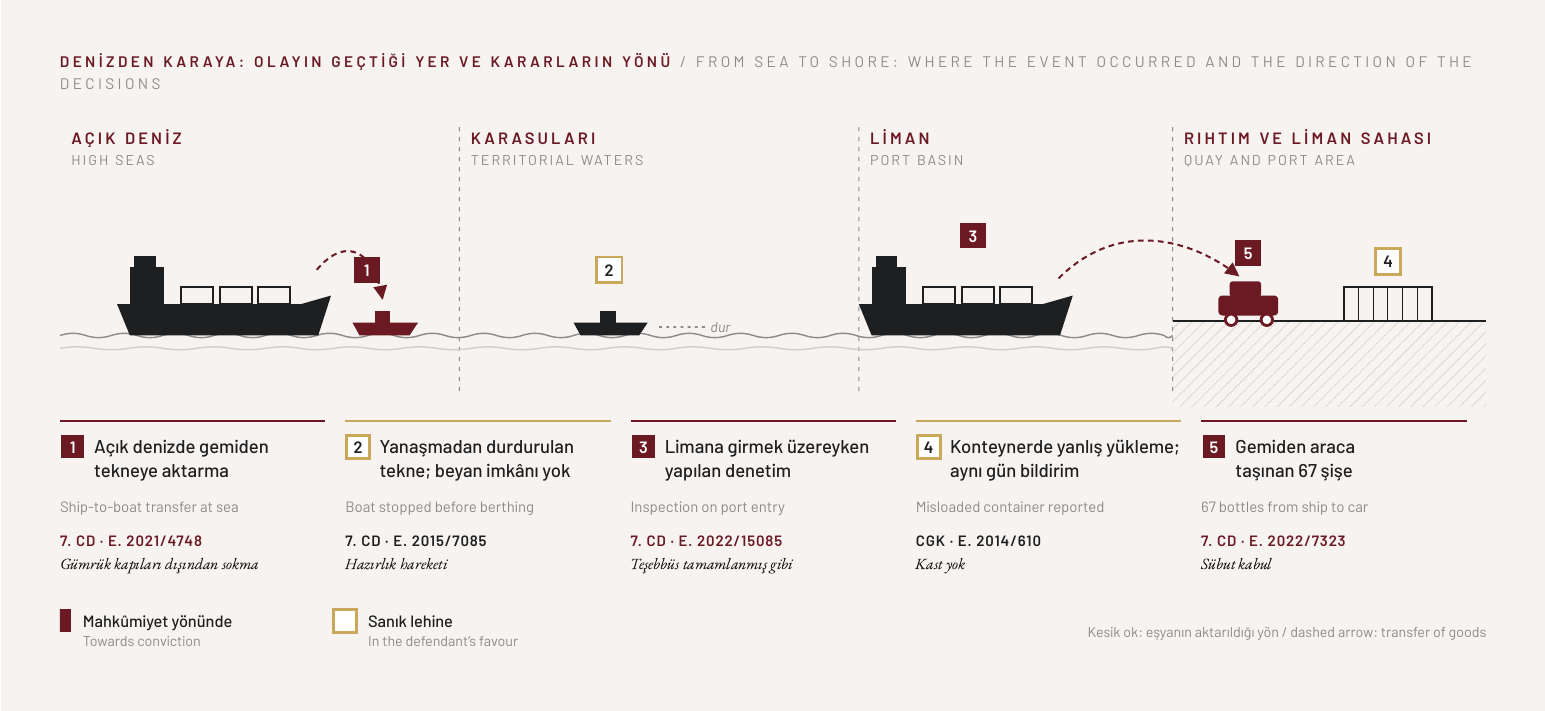
From sea to shore: where the event occurred and the direction of the decisions.
When a ship arrives at a Turkish port, the ship’s stores, the fuel and the personal effects of the crew on board are declared to the customs administration. Where there is a discrepancy between the declaration and the goods actually on board, the same fact may give rise to different legal consequences that are not mutually exclusive. If intent is found to exist, criminal proceedings are brought; in addition, or without any criminal proceedings, the taxes on the goods may be claimed separately under customs and tax legislation. In many cases, the outcome of the criminal proceedings depends not only on the size of the discrepancy but also on how the goods came on board, where they were kept, who prepared the declaration and what was done after the event.
Files in which undeclared goods are found on board a ship differ from those concerning land vehicles in three respects. First, a ship carries tax-exempt stores and fuel to be consumed during the voyage; the presence of cigarettes, alcoholic beverages or fuel on board does not, therefore, in itself give rise to a suspicion of smuggling. Secondly, the declaration documents on board are prepared not by a single person but with the contribution of the master, the chief engineer and the agent, according to the division of duties. Thirdly, in the case of fuel, the discrepancy is determined not by counting but by tank measurement, and the measurement itself becomes a matter of technical dispute.
The smuggling offence is regulated in Article 3 of Anti-Smuggling Law No. 5607 (“ASL”). The mental element of the offence is intent. In files where no link can be established between the presence of undeclared goods on board and an intent on the part of the master or a crew member to evade customs formalities, the Court of Cassation upholds acquittals or reverses convictions in favour of the defendant. By contrast, the transfer of goods from the ship to the shore or to another vessel, a deliberately incomplete declaration and a defence that conflicts with the documents are assessed in favour of conviction.
The article is based on decisions of the 7th and 19th Criminal Chambers and of the Criminal General Assembly of the Court of Cassation concerning ships, boats and port incidents. Decisions concerning land incidents are referred to by analogy only, and this is indicated in each case. Decisions of the tax and administrative courts are discussed in so far as they relate to the criminal route. Decisions of the regional courts of appeal have been assessed only to the extent that they are reported in decisions of the Court of Cassation, and decisions rendered by the first-instance courts following reversals have not been examined.
01
The Offence, the Customs Sanction and Tax AssessmentSuç, Gümrük Yaptırımı ve Vergi Tarhiyatı
Article 3(1) of the ASL penalises any person who brings goods into the country without subjecting them to customs formalities. Where the goods are fuel, tobacco products or alcoholic beverages, the penalty is increased under paragraph 10 of the same article.
Statutory provisionKanundaki düzenleme
Article 3(1) of the ASL reads as follows: “Any person who brings goods into the country without subjecting them to customs formalities shall be punished with imprisonment of one to five years and a judicial fine of up to ten thousand days. Where the goods are brought into the country other than through customs gates, the penalty to be imposed shall be increased by one third to one half.” Under paragraph 10 of the same article, where the goods are fuel, tobacco products or alcoholic beverages, “the penalties to be imposed under the preceding paragraphs shall be increased by one half to two times; however, the penalty imposed through the application of this paragraph may not be less than three years.”
Alongside the criminal proceedings there is also a sanction applied by the customs administration. Under Article 235(3) of Customs Law No. 4458 (“CL”), the customs duties on goods of passengers which fall outside the scope of personal and gift items and are found, contrary to their declarations, on their person, among their belongings or in means of transport are collected at twice the amount and the goods are delivered to their owner; if the duties are not paid, the goods are deemed abandoned to customs. In its decision dated 21 February 2019, E. 2017/11546, K. 2019/17131, the 7th Criminal Chamber of the Court of Cassation reversed the judgment against a defendant who was master of a ship on which 667 cartons of cigarettes not shown in the ship’s declaration were found, on the ground that “it being understood from the entire file that the defendant lacked criminal intent, a conviction was entered in writing instead of an acquittal”, and stated that the cigarettes should not be confiscated but delivered to the customs administration under that paragraph.
The legal regime governing ship’s stores is set out in Article 176 of the CL. Under paragraph 1 of that article, the fuel and lubricants that ships will use on foreign voyages and “the stores they bring from abroad on condition that they are not landed are exempt from import duties.” Under Article 476 of the Customs Regulation, as reported in the decision of the Plenary Session of the Administrative Law Chambers of the Council of State dated 7 January 2026, E. 2025/2275, K. 2026/20, stores, including food, beverages, cigarettes and alcoholic beverages, are supplied to means of transport under the transit regime. Under the same provision, “in order for Turkish-flagged sea and air vessels to benefit from this provision, they must consume such goods from the port from which they depart on a foreign voyage.” Under the Regulation on Duty-Free Shops, as reported in the decision, one ship-supply shop may be opened in each of the Istanbul and Çanakkale Straits. The exemption of stores from duty depends on their being supplied to the ship under the transit regime and on their not being landed.
For fuel, the tax route operates separately. In its decision dated 28 January 2019, E. 2018/3848, K. 2019/14, the 1st Tax Chamber of the Istanbul Regional Administrative Court found lawful a special consumption tax assessment made because transit fuel had been used on a domestic voyage of a Turkish-flagged ship, and concluded that “the said fuel should be taxed on the basis of the differences determined according to the engine log and the entry and exit declarations.” In its decision dated 6 November 2019, E. 2019/2419, K. 2019/2747, the same Chamber upheld an assessment with a tax loss penalty in a case concerning domestic voyages by a ship arriving from a foreign port, on the basis that “proceeding to an external voyage without taking on export cargo is not regarded as a continuation of the voyage to a foreign country and the transit regime has ended.” In its decision dated 31 January 2014, E. 2010/3532, K. 2014/403, the 7th Chamber of the Council of State held the agent jointly and severally liable for the tax together with the shipowner under Articles 183 and 192 of the CL, in a case where transit fuel had been used on a domestic voyage.
In our assessment, these decisions show that a discrepancy in fuel is not confined to criminal proceedings. The use of transit fuel on a domestic voyage may also be linked to the offence under Article 3(3) of the ASL of leaving transit goods in the customs territory in breach of the regime. The outcome of the criminal proceedings does not of itself determine the outcome of the tax dispute. The fact that the tax courts calculate the discrepancy on the basis of the engine log and the declarations, however, offers a method that may also be used when the measurement discrepancy is disputed in the criminal file. While the agent’s liability for tax rests on specific provisions of the CL, criminal liability requires intent to be separately proved in respect of the agent.
In plain termsSade anlatımla
Where undeclared goods are found on board, the criminal route and the tax route may operate separately. A conviction in criminal proceedings requires proof of intent. Even in the absence of intent, the tax on the goods and a tax penalty may be claimed separately. Whether the master and crew members are to be regarded as “passengers” for the purposes of the double-duty rule applicable to passengers has not, however, been expressly discussed in the decisions.
02
No Declaration, Under-Declaration and Over-DeclarationHiç Beyan, Eksik Beyan ve Fazla Beyan
Three SituationsÜç Durum
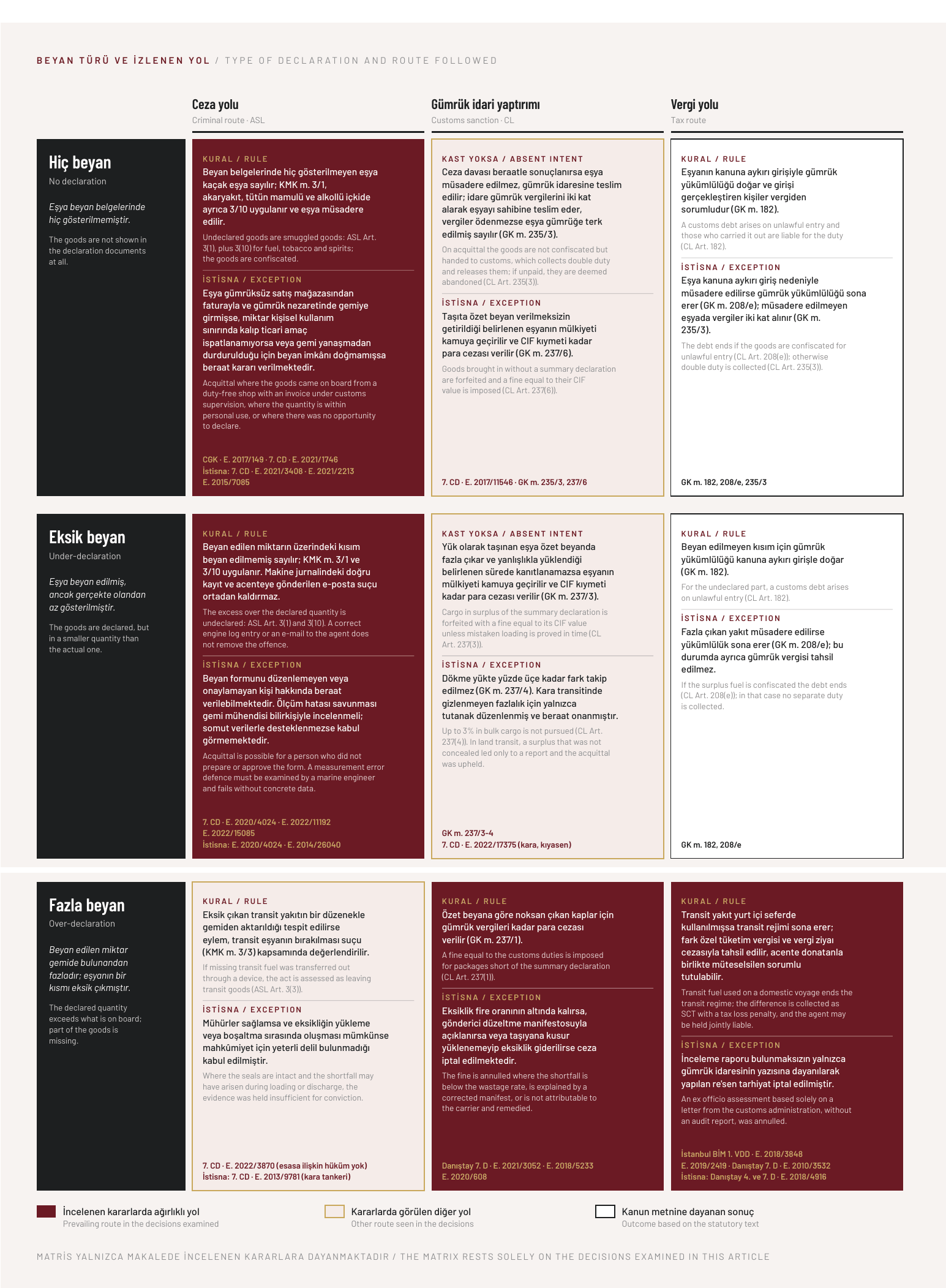
On board ship, a mismatch between the declaration and the actual position arises in three forms. In the first, the goods are not shown in the declaration documents at all; the master’s declaration letter states that there are no smuggled goods, yet cigarettes or spirits are found on board. In the second, the goods are declared but in a quantity smaller than the actual one; in ship’s fuel, this is what practice calls a “declaration surplus”. In the third, the declared quantity exceeds what is on board; in other words, part of the goods is found to be missing. In this article these situations are referred to as no declaration, under-declaration and over-declaration respectively.
The legislation attaches these situations to different provisions. Article 3(1) of the ASL penalises bringing goods into the country without subjecting them to customs formalities, and Article 3(2) penalises bringing goods into the country through deceptive acts and conduct without paying the customs duties in whole or in part. Article 3(3) regulates as a separate offence leaving transit goods in the customs territory in breach of the regime. Article 237 of the CL, for its part, provides for a fine for packages found short against the summary declaration and, for surplus packages, for forfeiture of the goods and a fine equal to their CIF value; paragraph 6 of the same article governs goods brought in without a summary declaration.
Statutory provisionKanundaki düzenleme
Article 237(4) of the CL reads as follows: “No proceedings shall be taken for shortfalls and surpluses in goods arriving in bulk at rates, not exceeding three per cent, to be determined by Presidential decision according to the type of goods. For natural gas products, excluding those imported by pipeline, this rate shall be applied so as not to exceed 6%.” The provision concerns cargo carried in bulk; in the criminal decisions examined, this rate was not relied on with regard to the ship’s own fuel.
No Declaration and Under-Declaration: Same Provision, Different ProofHiç Beyan ve Eksik Beyan: Aynı Hüküm, Farklı İspat
Goods not declared at all are treated as smuggled goods in the decisions of the Court of Cassation. In its decision dated 27 February 2018, E. 2017/149, K. 2018/71, concerning a container at the port of Izmir in which goods of commercial quantity not shown in the declaration for release for free circulation were found, the Criminal General Assembly of the Court of Cassation held, on the basis that there had been an “attempt to bring [the goods] into the country without subjecting them to customs formalities by not declaring them”, that the conditions for confiscation of the goods were met although the case had lapsed through limitation. The part concerning confiscation was decided by majority. The decision with docket No. 2021/1746, concerning cigarettes and spirits not shown in the ship’s stores declaration, points in the same direction.
In the case of under-declaration, too, the Court of Cassation does not apply a different provision. In decisions concerning ship’s fuel, the part exceeding the declared quantity is treated as undeclared goods and paragraphs 1 and 10 of Article 3 of the ASL are applied. In the file with docket No. 2020/4024, the first-instance court, relying on an expert report, had accepted that fuel declared short by mistake was not smuggled goods; the Chamber did not share that view and concluded that “the fact that the situation was noticed through the record of 31.7 tonnes in the engine log kept by the chief engineer does not remove the offence”. In the file with docket No. 2022/11192, the regional court of appeal had accepted that an offence concerning transit fuel would arise only if the fuel were left in the customs territory, whereas the Chamber assessed the act under paragraphs 1 and 10.
In land transport, by contrast, whether undeclared surplus goods were concealed may be decisive. In its decision concerning a transit load carried from Greece to Iraq in which undeclared spare parts were found (by analogy), dated 29 March 2023, E. 2022/17375, K. 2023/3055, the Chamber reported, by reference to the Customs General Communiqué on transit operations, that proceedings are to be taken under the ASL where the surplus is concealed or found in a hiding place and that otherwise only a report is to be drawn up, and upheld the acquittal on the ground that “in the case at hand the undeclared goods were not concealed or caught in a hiding place”.
In our assessment, in the decisions examined there is no difference, with regard to ships, between no declaration and under-declaration as to the provision applied; in both situations the undeclared quantity is treated as smuggled goods. The difference emerges at the stage of proof: for goods not declared at all, the question is how the goods came on board and why they were not declared, while for under-declaration it is whether the discrepancy can be explained by measurement error.
Over-Declaration: Goods Found MissingFazla Beyan: Eksik Çıkan Eşya
Where the declared quantity exceeds what is on board, the matter remains, in the decisions examined, predominantly within the sphere of the customs administration and the administrative courts. Packages found short against the summary declaration are subject to Article 237(1) of the CL. In its decision dated 9 October 2023, E. 2021/3052, K. 2023/3765, concerning diesel carried by ship and discharged into a bonded warehouse with a shortfall of 89,330 kg against the summary declaration, the 7th Chamber of the Council of State upheld a judgment annulling the fine on the ground that the shortfall remained below the wastage rate. In its decision dated 11 April 2023, E. 2020/608, K. 2023/2027, concerning containers listed in the bill of lading some of which were not found on the ship, the same Chamber likewise upheld an annulment on the grounds that no fault could be attributed to the claimant and the shortfall had in fact been remedied.
A shortfall in the ship’s own transit fuel, on the other hand, may lead to two different outcomes. If the fuel was used on a domestic voyage, the difference is settled through special consumption tax and a tax loss penalty, as in the regional administrative court decisions discussed above. If it is established that the fuel was transferred from the ship by means of a device, the criminal route comes into play: in its decision dated 4 June 2024, E. 2022/3870, K. 2024/6350, concerning a tanker with a shortfall of 6,086 kg in sealed transit fuel tanks and a device enabling fuel to be transferred out without breaking the seals, the Chamber stated that the act should be assessed as leaving transit goods. No ruling on the merits was made in that decision; the file was sent back to remedy a defect in service.
In our assessment, the basic question in over-declaration is where the missing goods went. If the shortfall can be explained by wastage, a loading error or a corrected manifest, the outcome remains confined to an administrative sanction, and sometimes no sanction is imposed at all; if it is proved that the goods were removed from the ship and left in the country, the offence relating to transit goods comes into play. In under-declaration, by contrast, the question is why the surplus goods were not declared.
03
Criteria for Cigarettes and AlcoholSigara ve Alkolde Ayrım Ölçütleri
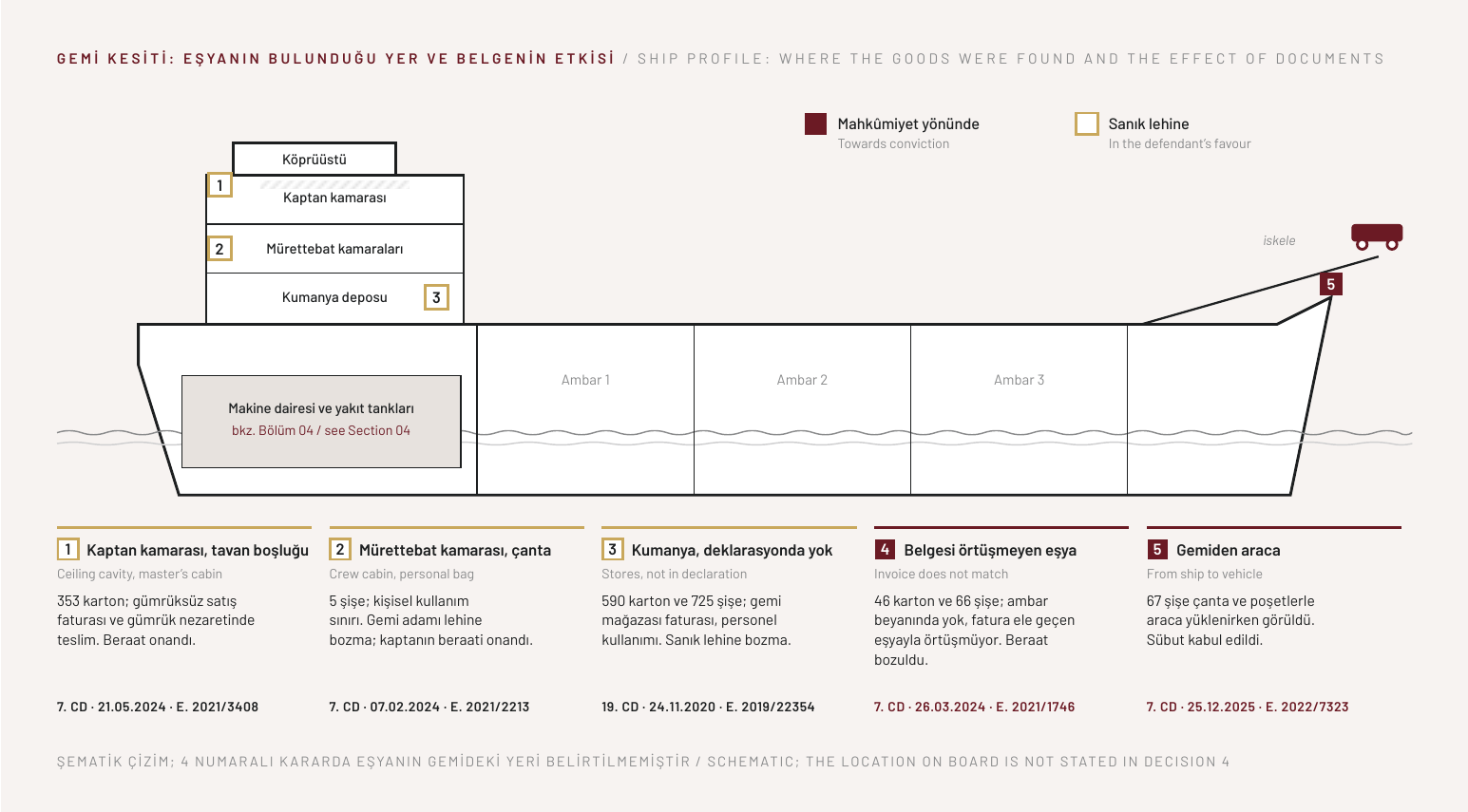
Ship profile: where the goods were found and the effect of documents. Schematic; the location on board is not stated in decision 4.
Goods Arriving with DocumentsBelgeyle Gelen Eşya
In cigarette and alcoholic beverage files, the fact that stands out in decisions with an outcome favourable to the defendant is that it has been documented that the goods came on board through a lawful channel. In the case underlying the decision of the 7th Criminal Chamber of the Court of Cassation dated 21 May 2024, E. 2021/3408, K. 2024/5670, 353 cartons of cigarettes hidden in the ceiling cavities of the master’s cabin and the adjoining room were found on a dry cargo ship. The Chamber took into account that 350 cartons of the cigarettes had been purchased with an invoice from the duty-free shop in Çanakkale, that the invoice had been submitted to the customs administration and the cigarettes delivered to the ship under the administration’s supervision, that under Circular No. 2013/8, in force on the date of the offence, up to 750 cartons of cigarettes could be sold to a ship, and that invoices bearing earlier dates had also been submitted for the remaining 3 cartons. The master argued that he had forgotten to declare the cigarettes and had hidden them so that the excess would not be seized at the next foreign port of call. The Chamber unanimously upheld the acquittal.
In its decision dated 24 November 2020, E. 2019/22354, K. 2020/16631, the 19th Criminal Chamber of the Court of Cassation likewise stated the following with regard to 590 cartons of cigarettes and 725 bottles of spirits not shown in the ship’s declaration: “in view of the defendant’s defence at all stages that he had purchased the seized products for use by the ship’s personnel and for hospitality by the shipowner, it being understood from the entire file that the defendant lacked criminal intent, a conviction was entered in writing instead of an acquittal”. In that case, the goods had been purchased with an invoice from a shop supplying ships and the cigarettes bore a duty-free sale marking.
The existence of a document is not sufficient in itself; the document must match the goods seized. In its decision dated 26 March 2024, E. 2021/1746, K. 2024/3344, the 7th Criminal Chamber of the Court of Cassation reversed the acquittal of a defendant on whose ship, of which he was master, 46 cartons of cigarettes and 66 bottles of spirits without tax stamps had been seized. The decision stated that “since the invoice was dated 12.04.2015 and the search on the ship took place on 13.04.2015 at 14.20, the seized goods subject to the offence did not match the content of the invoice.” The goods had not been shown in the ship’s stores declaration, the sea route declaration form and the master’s declaration letter stated that there were no smuggled goods, and the defendant himself said that he knew the goods had to be declared but had not declared them because they were few in number.
In our assessment, when these decisions are read together, documentation of the channel through which the goods came on board stands out as an important fact in the assessment of intent with regard to cigarettes and alcohol on board. Nevertheless, the decision with docket No. 2021/3408 is one that upholds the first-instance court’s assessment of the evidence. In that file, the goods had been supplied to the ship from a duty-free shop in Türkiye under the supervision of the customs administration, and the master argued that the concealment was intended to prevent seizure at the next foreign port. The decision does not establish a general principle that concealment is irrelevant to the proof of intent. Where there is a mismatch between the document and the goods as to date, quantity or type, the same document weakens the defence and acquittals may be reversed. The limit in Circular No. 2013/8 was applied in the decision as at the date of the offence, and the current status of the Circular has not been separately examined in this article.
Quantity and Personal UseMiktar ve Kişisel Kullanım
With regard to the personal effects of crew members and yacht personnel, the Chamber requires concrete evidence that the goods were held for commercial purposes. In its decision dated 7 February 2024, E. 2021/2213, K. 2024/985, the Chamber reversed the conviction of a crew member on a passenger ship arriving in Fethiye from Rhodes in whose bag 5 bottles of spirits were found, on the ground that the quantity remained within the limit of personal use and the commercial purpose could not be proved. In its decision dated 17 January 2024, E. 2021/3479, K. 2024/478, the Chamber likewise reversed the conviction of a crew member in respect of 8 bottles of spirits seized on a Turkish-flagged yacht, concluding that “in view of the manner in which the goods were seized and the quantity seized, no evidence sufficient for punishment, free from any doubt, conclusive and convincing, could be obtained that, contrary to his defence, the defendant held the goods subject to the offence for commercial purposes.”
Commercial purpose is not written as a separate element in Article 3(1) of the ASL; the Chamber applies this criterion in assessing intent with regard to goods within the limit of personal use. In the decision with docket No. 2021/3479, Article 235(3) of the CL does not appear in the Chamber’s reasoning. Whether a crew member performing his duties is to be regarded as a “passenger” within the meaning of that paragraph has not been expressly discussed in the decisions; by contrast, in the decision with docket No. 2017/11546 referred to above, the Chamber relied on that paragraph with regard to the master’s undeclared cigarettes. In our assessment, the limit applicable to the personal effects of crew members is a question that should be assessed separately within the framework of the customs provisions on the personnel of means of transport.
Transfer of Goods from the Ship to the Shore or to Another VesselEşyanın Gemiden Karaya veya Başka Tekneye Aktarılması
The fact that stands out in decisions in favour of conviction is the removal of the goods from the ship. In its decision dated 25 December 2025, E. 2022/7323, K. 2025/16888, the Chamber accepted that the offence was proved “in a case where 67 bottles of alcoholic beverages found to belong to the defendant were seized during a search carried out after it was seen that certain goods in black bags and carrier bags were being loaded from the ship into a vehicle by the defendant, a seaman,” coming from a ship arriving from a Greek island. The judgment was reversed because paragraphs 1 and 10 had not been applied by reference to the last sentence of paragraph 18 of Article 3 of the ASL and no decision had been made on the confiscation of the vehicle.
In transfers from a ship to a boat at sea, the Chamber likewise accepts that the goods were brought into the country other than through customs gates. In its decision dated 7 June 2021, E. 2021/4748, K. 2021/7423, rendered in a file where the offence was committed in 2008, the Chamber reversed the judgment as to the legal characterisation of the offence with regard to smuggled cigarettes loaded at sea from a ship arriving from Egypt onto a boat and landed on the Tarsus shore, stating that the boat operator’s act fell within the second sentence of Article 3(1) of the ASL. In the decision dated 23 January 2024, E. 2023/13223, K. 2024/659, concerning the period of Law No. 1918, a conviction for collective smuggling was likewise upheld after cargo had been passed from a ship carrying transit cigarettes, while at anchor, to a fishing boat and counterfeit tax stamps had been detected.
One further point should be made as to the legal characterisation of the offence. In its decision dated 9 April 2025, E. 2024/392, K. 2025/155 (by majority) and its decision dated 11 March 2026, E. 2024/234, K. 2026/144 (unanimously), both concerning fuel brought across the land border, the Criminal General Assembly of the Court of Cassation held that, since paragraph 10 as amended by Law No. 6455 and applied as the more lenient law “constitutes an independent type of offence by reason of its subject matter”, the increase under the second sentence of paragraph 1 could not be applied. Paragraph 10 was converted by Law No. 6545 into a provision increasing the penalty to be imposed under the preceding paragraphs. Indeed, in its decision with docket No. 2022/11192 discussed below, the 7th Criminal Chamber of the Court of Cassation applied paragraphs 1 and 10 together. In our assessment, the effect of the decisions of the Criminal General Assembly remains confined to files in which the text as amended by Law No. 6455 is the more lenient law as at the date of the offence.
DecisionFactsOutcomeDecisive fact
7th CC, 21.02.2019, E. 2017/11546667 undeclared cartonsReversed in the defendant’s favourInvoice; absence of intent
19th CC, 24.11.2020, E. 2019/22354590 cartons and 725 bottlesReversed in the defendant’s favourInvoice; crew use defence
7th CC, 07.02.2024, E. 2021/22135 bottles in a crew member’s bagReversed in the crew member’s favourLimit of personal use
7th CC, 26.03.2024, E. 2021/174646 cartons and 66 bottlesAcquittal reversedInvoice date does not match the search
7th CC, 21.05.2024, E. 2021/3408353 cartons in ceiling cavityAcquittal upheldInvoice and delivery under customs supervision
7th CC, 25.12.2025, E. 2022/732367 bottles carried from ship to vehicleOffence proved; judgment reversed on other groundsTransfer of goods ashore
Decisive facts concerning cigarettes and alcohol seized on board (CC: Criminal Chamber of the Court of Cassation)
04
Fuel Discrepancies: Measurement and IntentAkaryakıtta Beyan Farkı: Ölçüm ve Kast
Establishing the DiscrepancyFarkın Tespiti
In ship’s fuel, the discrepancy is determined by comparing the quantity reported in the declaration documents on the ship’s arrival with the quantity found in the tank measurement carried out by an independent survey company. In the decisions, the size of the discrepancy and whether objections to the measurement method are supported by concrete data are of importance.
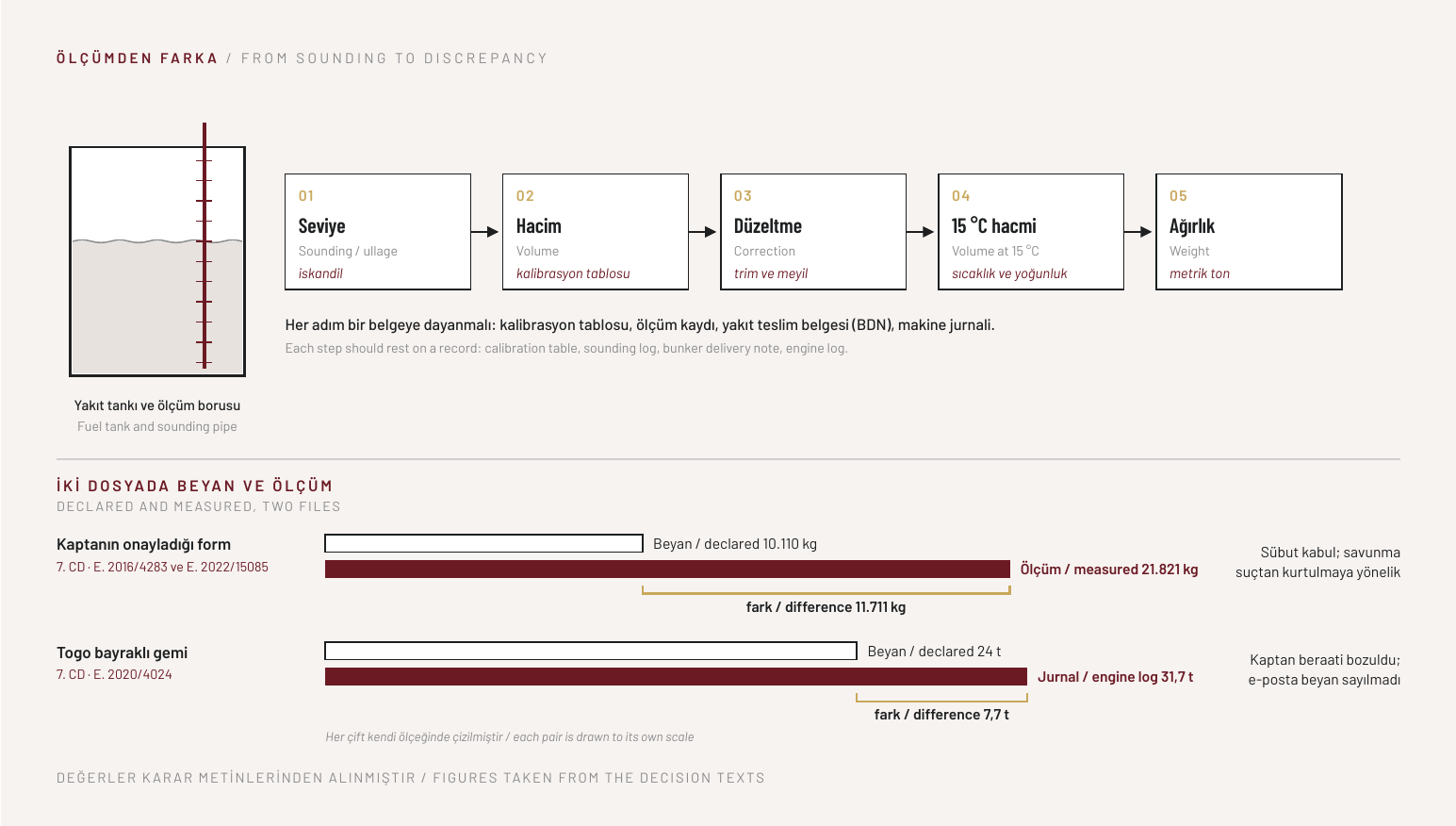
From sounding to discrepancy. Figures taken from the decision texts.
In its decision dated 12 June 2024, E. 2022/11192, K. 2024/6478, the Chamber reversed the acquittal rendered by the regional court of appeal in a case where 9,960 kg of diesel and 33,440 kg of fuel oil were found undeclared on a Mongolian-flagged LPG tanker. The regional court of appeal had relied on the possibility that the sounding pipes were blocked, the age of the ship, the fact that the master was not responsible for fuel calculations and the fact that the expert had not identified any intent. The Chamber, however, held as a ground for reversal that an acquittal had been rendered “instead of, taking into account the place where the goods were seized, their quantity, the manner in which the event occurred, the statements of the defendants and the entire file, accepting that the offence was proved and convicting the defendants under Articles 3/1 and 3/10 of Law No. 5607”. In its decision dated 26 April 2023, E. 2022/9296, K. 2023/3976, the Chamber likewise did not accept the measurement error defence with regard to 16,916 kg of undeclared transit fuel identified by independent measurement on a Palau-flagged ship and concluded that “the defendants’ act was established”; the judgment was, however, reversed on grounds such as the need to assess more lenient provisions that entered into force subsequently.
A file in which two decisions were rendered against the master illustrates the limit of the measurement error defence. In that case, 10,110 kg of diesel was declared in the sea route declaration form prepared by the chief engineer (referred to in the decision as the “başmakinist”) and approved by the master, while 21,821 kg of diesel was found on measurement. The Chamber first reversed the acquittal by its decision dated 21 May 2018, E. 2016/4283, K. 2018/5592, and subsequently, in its decision dated 21 June 2023, E. 2022/15085, K. 2023/6431, concluded that “in view of the seizure, during the inspection of a ship about to enter port to make entry into the country, of a total of 11,711 kg of undeclared diesel of commercial quantity and nature, the smuggling offence charged has been proved,” finding the master’s defence based on measurement error to be aimed at escaping liability. The judgment was reversed on account of the error in the effective repentance warning discussed below.
The Technical Nature of Measurement and the ExpertÖlçümün Teknik Niteliği ve Bilirkişi
In files based on measurement discrepancies, the Court of Cassation reviews the expert’s field of expertise. In its decision dated 20 April 2016, E. 2014/26040, K. 2016/5841, the Chamber reversed an acquittal based on the report of a customs consultant expert and stated that a decision should be rendered “taking into account that the measurement of the fuel on board is a matter requiring technical knowledge of seamanship, by referring the file to an expert who is a marine engineer with knowledge of the subject”. Although the decision was rendered against the acquittal, it shows that the parties’ objections concerning measurement must be assessed with the knowledge of marine engineering.
In its decision dated 12 December 2017, E. 2016/114, K. 2017/544, the Criminal General Assembly of the Court of Cassation likewise reversed a conviction in a file concerning fuel brought by ships, in which the discrepancy had been determined by comparing invoices with declarations. The reversal rests not on the substance of the measurement but on the fact that “the reasons why a total of eleven expert reports containing views differing from the facts accepted by the local court were not relied on were not shown in the decision”, that is, on insufficient reasoning. The decision was rendered by majority, with three members dissenting on the view that the objection should have been dismissed.
By contrast, general objections to the measurement method do not prevent a conviction. In its decision dated 15 April 2026, E. 2022/11498, K. 2026/4645, the Chamber, despite objections raised in the appeal petition concerning the sounding table, the loading condition and trim correction, concluded without separately discussing those objections that “the reports on which the judgment was based were sufficient” and upheld the conviction.
In our assessment, the success of the defence in fuel files depends on showing with documents where the measurement discrepancy originates. A tank measurement first yields a volume, and the weight equivalent is obtained by correction for density and temperature. The tank calibration table, trim and list correction, the bunker delivery note, daily sounding records and the engine log should therefore be assessed together and should be consistent with one another. Where the discrepancy clearly exceeds the margin of measurement error and the technical explanation is not based on concrete data, the size of the discrepancy is treated in the decisions examined as an indicator of intent.
In plain termsSade anlatımla
In fuel cases the key question is whether the difference between the declared quantity and the measured quantity can be explained by measurement error. This is assessed by a marine engineer expert. Defences of “measurement error” and “old ship” unsupported by documents have not been accepted in the decisions examined.
DecisionFactsOutcomeDecisive fact
7th CC, 20.04.2016, E. 2014/26040Acquittal based on customs consultant’s reportAcquittal reversedMarine engineer expert required
7th CC, 10.04.2019, E. 2018/5047Fuel exceeding the quantity in the formAcquittal reversedAttempt punished as a completed offence
7th CC, 26.04.2023, E. 2022/929616,916 kg of transit fuelOffence proved; judgment reversed; return of ship upheldIndependent measurement
7th CC, 21.06.2023, E. 2022/1508511,711 kg of undeclared dieselOffence proved; reversed for warning errorDefence found aimed at escaping liability
7th CC, 29.11.2023, E. 2020/402424 tonnes declared, 31.7 tonnes in logMaster’s acquittal reversed; chief engineer’s acquittal upheldMaster who prepared the form
7th CC, 12.06.2024, E. 2022/111929,960 kg diesel, 33,440 kg fuel oilRegional court of appeal acquittal reversedPlace, quantity and circumstances
Decisive facts concerning fuel discrepancies on ships (CC: Criminal Chamber of the Court of Cassation)
05
Personal Liability: Master, Chief Engineer and Crew MemberKişisel Sorumluluk: Kaptan, Başmühendis ve Gemi Adamı
The Person Who Prepares the DeclarationBeyanı Düzenleyen Kişi
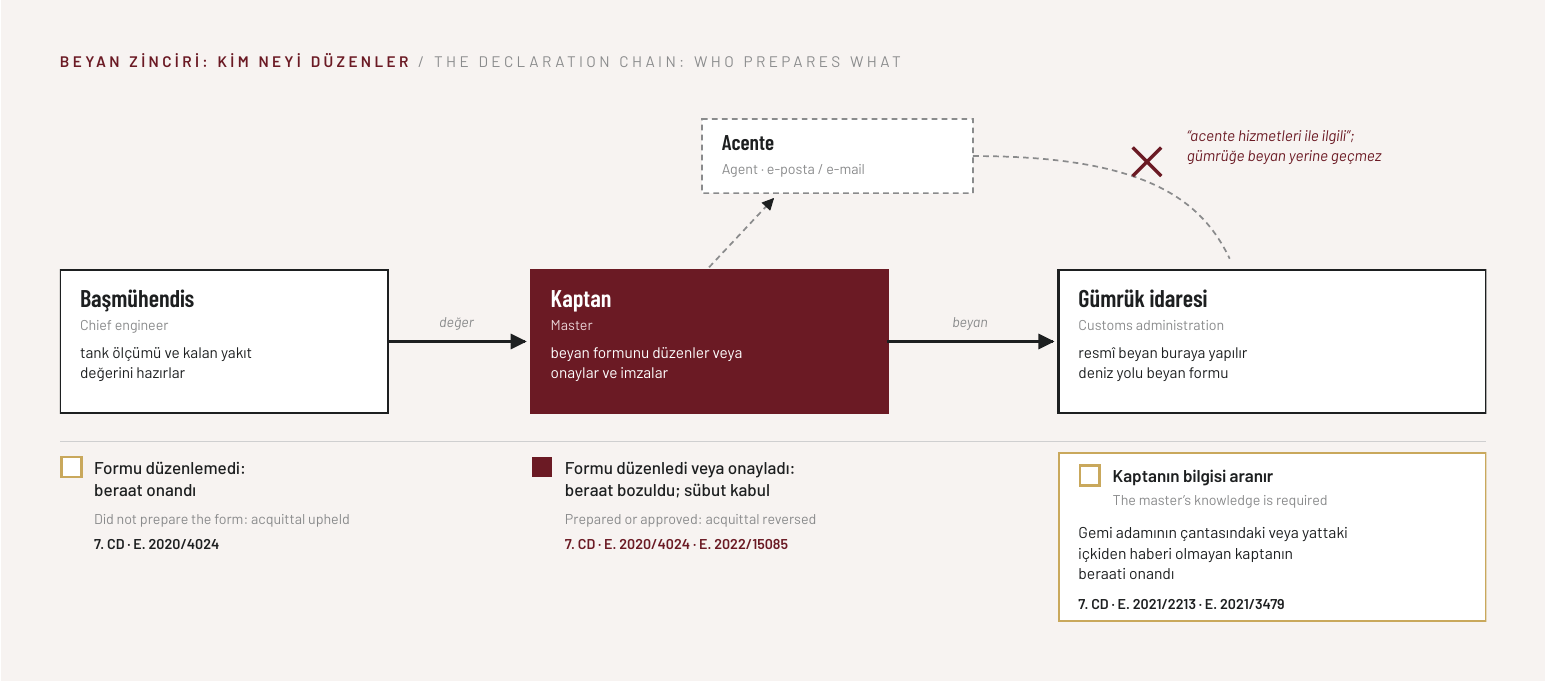
In the decisions, liability carries weight with regard to the person who prepares or approves the declaration document. In the case underlying the decision of the 7th Criminal Chamber of the Court of Cassation dated 29 November 2023, E. 2020/4024, K. 2023/10504, 24 metric tonnes of fuel were declared on a Togo-flagged ship in the sea route declaration form and the IMO forms, while 31.7 metric tonnes appeared in the engine log. The master argued that he had notified the correct quantity to the agent by e-mail and that the figure in the form was a typing error. The Chamber did not accept this defence and reversed the master’s acquittal on the ground that the e-mail “related to agency services, whereas the official declaration of transit fuel is the declaration made to the Customs Administration”. By the same decision, the acquittal of the chief engineer, who had not prepared the declaration form, was unanimously upheld.
In our assessment, the fact that two different outcomes arose on the same ship shows that liability is determined not by rank but by participation in the act of declaration and by proof of intent through concrete facts. In the file concerning a form prepared by the chief engineer and approved by the master, the Chamber likewise first reversed the acquittal by its decision with docket No. 2016/4283 and, in its decision with docket No. 2022/15085, accepted that the offence was proved with regard to the master who had approved the form.
The declaration chain: who prepares what.
The Master’s Knowledge and the Circumstances of the EventKaptanın Bilgisi ve Olayın Oluşu
With regard to the personal effects of crew members, the master’s knowledge is examined separately. In the decision with docket No. 2021/2213, the acquittal of the master, who said he had no knowledge of the spirits in the crew member’s bag, was upheld; in the decision with docket No. 2021/3479, the acquittal of the yacht-owning master, who stated that he had no knowledge of the spirits seized on the yacht, was likewise upheld.
By contrast, there are decisions in which the knowledge of the personnel of a means of transport is inferred from the circumstances of the event. In its decision concerning a bus (by analogy) dated 20 May 2025, E. 2021/11068, K. 2025/7717, the 7th Criminal Chamber of the Court of Cassation concluded that it was “not possible for the spirits and cigarettes to be loaded into the vehicle without the knowledge and consent of the defendant ..., the bus driver, and the defendant ..., the bus assistant”. By contrast, in its decision concerning a land vehicle (by analogy) dated 6 December 2021, E. 2021/6452, K. 2021/16494, the Chamber accepted that there was no conclusive evidence of the participation of a driver who argued that he had taken over the vehicle with a full tank.
In our assessment, in the decisions examined, the master’s criminal liability is based not on his being responsible for all the goods on board but on proof of intent through concrete facts. With regard to a master who prepares or approves the declaration form, however, the Chamber treats the incomplete declaration in the form as a strong fact in proving intent and does not accept defences of typing or measurement error unless supported by concrete data. Where the location or quantity of the goods on board makes it impossible for them to have been placed on board without the knowledge of the personnel, there is also a risk that knowledge will be inferred from the circumstances of the event.
Statutory provisionKanundaki düzenleme
Article 7(1) of the ASL reads as follows: “Where, without a legally valid excuse, a ship enters the customs territory without permission and comes alongside the shore or another ship, the master of the ship shall be punished in accordance with the provisions of this Law on the smuggling offence if prohibited goods, or goods not included in the loading or carriage documents, are found on board.”
The paragraph makes the master’s liability for goods not included in the documents conditional upon unauthorised entry and coming alongside. In our assessment, in the case of ships entering port with permission, the master’s liability is determined, as in the decisions discussed above, under Article 3 of the ASL and according to proof of intent. In its decision dated 20 May 2026, E. 2025/3073, K. 2026/6135, the Chamber upheld the conviction entered by the regional court of appeal under Article 3 of the ASL against the master and the shipowner in a case in the Istanbul Strait where the ship had been declared empty, without separately discussing the objection raised in the appeal petition that the elements of Article 7 were not met.
06
Attempt, Effective Repentance and ProcedureTeşebbüs, Etkin Pişmanlık ve Usul
The Stage of the Act and the Opportunity to DeclareFiilin Aşaması ve Beyan İmkânı
Under Article 3(22) of the ASL, the acts defined in the article are punished as if completed even if they remained at the stage of attempt. In its decision dated 10 April 2019, E. 2018/5047, K. 2019/30136, the Chamber reversed an acquittal in a case where fuel exceeding the amount shown in the arrival, fuel and stores procedures form was found on a ship arriving from Ukraine, concluding, under the paragraph’s numbering at that time, that “under Article 3/21 of Law No. 5607, acts remaining at the stage of attempt must be accepted as a completed offence”. Following the addition of a new paragraph to the article by Law No. 7423, the provision was renumbered as paragraph 22.
The attempt provision does not cover preparatory acts. In its decision dated 3 May 2018, E. 2015/7085, K. 2018/4797, the Chamber stated the following with regard to a chartered boat which had loaded meat in Greece and was stopped in territorial waters before coming alongside in port: “a conviction was entered instead of an acquittal, taking into account that the act of being caught after taking the meat from Greece and before entering the country was in the nature of a preparatory act and that the defendant was not given the opportunity to make a declaration”. In our assessment, this decision concerns a boat whose operator had not been given the opportunity to make a declaration. In files where the declaration was prepared on the ship’s arrival or the inspection took place as the ship was about to enter port, the Chamber applies the attempt provision and rules in favour of conviction. Accordingly, while whether the opportunity to declare had arisen is one of the facts taken into account in assessing whether the act remained at the preparatory stage, the fact that the declaration document has not yet been submitted does not in itself mean that the offence is not committed.
In loading errors arising in the port area, subsequent notification is also taken into account in assessing intent. In its decision dated 18 December 2018, E. 2014/610, K. 2018/658, in a case where vehicle bodies were found in an “empty” container discharged from a ship into the port area, the Criminal General Assembly of the Court of Cassation took into account that the agent’s representative had made a notification through the port authorities on the day he learned of the situation and the line company’s letter on erroneous loading, and concluded that “it must be accepted that the defendants lacked the intent to commit an offence.” The fact that the defendants in that file were the agent’s representatives shows that the agent may also become a party to a smuggling investigation.
The Effective Repentance WarningEtkin Pişmanlık İhtarı
Statutory provisionKanundaki düzenleme
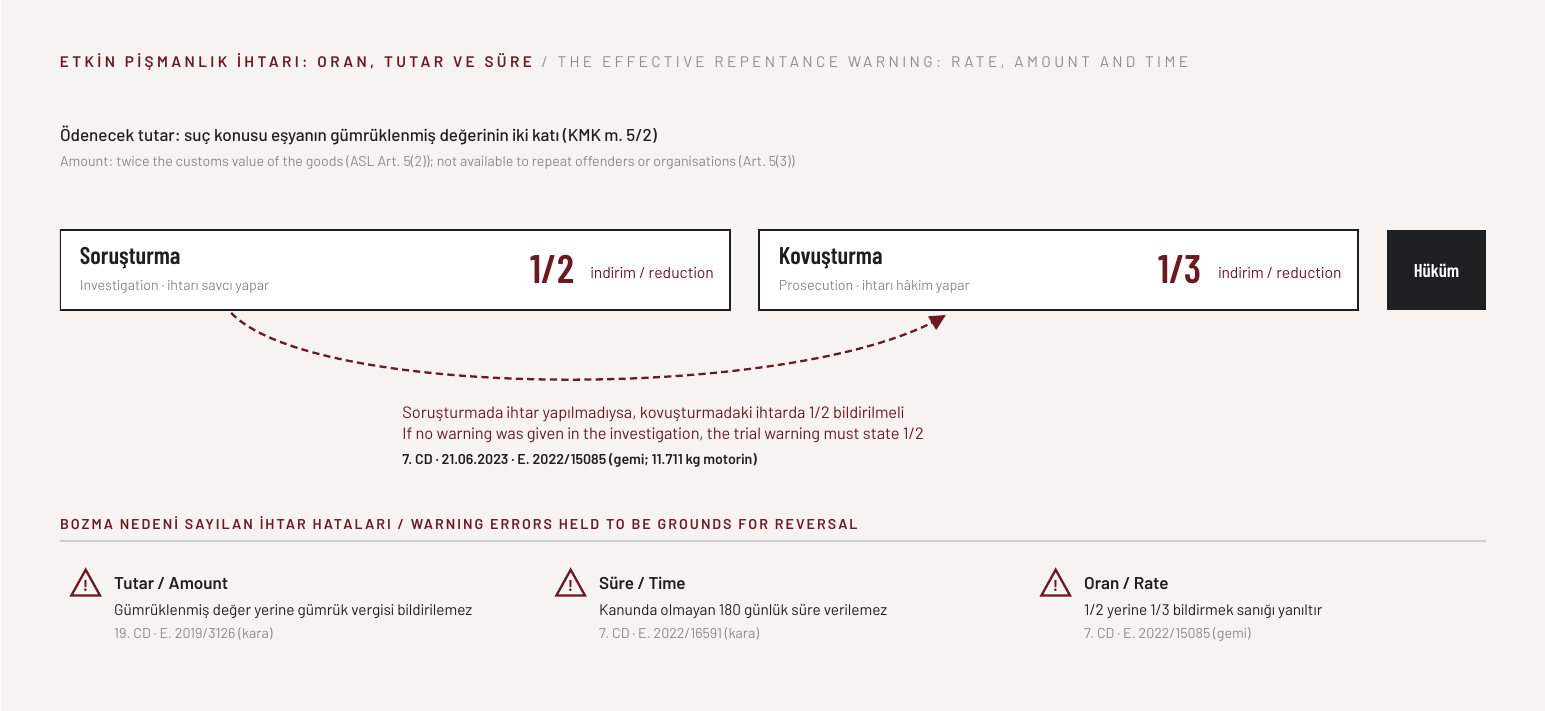
Under Article 5(2) of the ASL, the penalty of a person who pays to the State Treasury an amount equal to twice the customs value of the goods subject to the offence is reduced by one half if payment is made before the end of the investigation stage, and by one third if payment is made during the prosecution stage before judgment is rendered. The last sentences of the paragraph read as follows: “This matter shall be notified to the suspect by the public prosecutor during the investigation stage. If no warning is given during the investigation stage, the judge shall give the warning to the accused during the prosecution stage.”
The effective repentance warning: rate, amount and time.
Errors in the effective repentance warning are treated in decisions of the Court of Cassation as an independent ground for reversal. In the file concerning 11,711 kg of diesel discussed above, no warning was given during the investigation, and the court warned of a one-third reduction during the prosecution stage. In its decision with docket No. 2022/15085, the Chamber reversed the judgment on the ground that “no warning on effective repentance was given to the defendant during the investigation stage and, accordingly, misleading the defendant by notifying the reduction rate in the payment warning given during the prosecution stage as 1/3, whereas it should have been notified as 1/2, was found unlawful.” According to this decision, if no warning was given during the investigation stage, the warning given during the prosecution stage must state the one-half reduction.
The same review is carried out in decisions concerning land incidents (by analogy). In its decision dated 22 May 2019, E. 2019/3126, K. 2019/8842, the 19th Criminal Chamber of the Court of Cassation found unlawful the notification to the defendant of the customs duty instead of the customs value; in its decision dated 23 May 2024, E. 2022/16591, K. 2024/5798, the 7th Criminal Chamber found unlawful the granting of a 180-day payment period not provided for by law. These decisions show that the warning must comply with the law as to amount, rate and time. Under paragraph 3 of the same article, the effective repentance provision does not apply to repeat offenders or where the offence is committed within the activities of an organisation.
SearchArama
The lawfulness of a search carried out on a boat may also affect the outcome. In its decision dated 3 April 2023, E. 2023/3908, K. 2023/3172, the Chamber upheld an acquittal in a case where 2,000 litres of fuel were seized in a below-deck tank of a boat sailing with its navigation lights off and the national marker proved invalid. The earlier reversal decision reported in the decision stated, among other grounds, that “there was no duly issued search warrant of a court constituting the basis for a search concerning the defendant and the smuggled goods”. In our assessment, the extent to which this decision applies to inspections carried out by the customs administration during a ship’s arrival control should be assessed separately.
07
Measures Concerning the Ship: Seizure, Detention and ConfiscationGemi Üzerindeki Tedbirler: El Koyma, Alıkoyma ve Müsadere
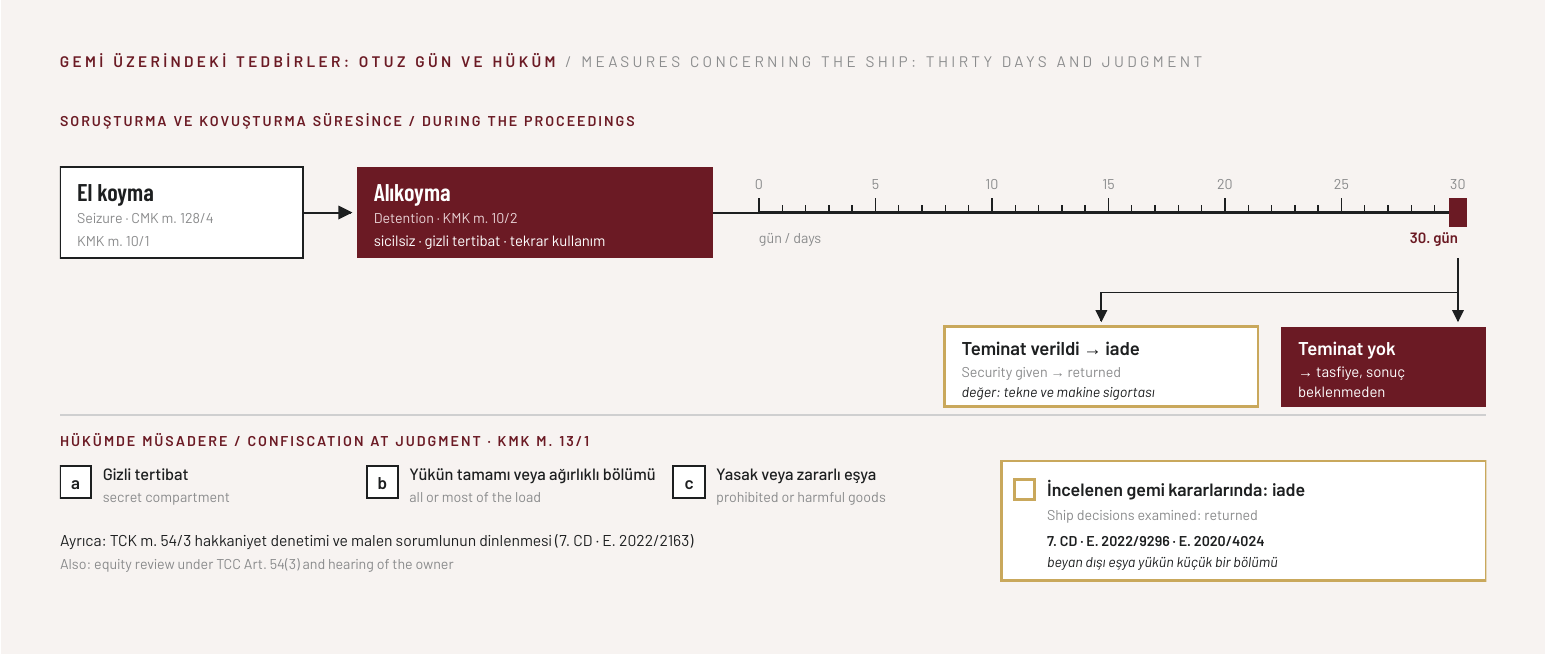
Measures concerning the ship: thirty days and judgment.
Vehicles used in committing the smuggling offence are seized under Article 10(1) of the ASL by application of Article 128(4) of the Code of Criminal Procedure. Under paragraph 2 of the same article, the vehicle is detained where it contains a secret compartment, is not registered in Türkiye or is used again for smuggling while proceedings are pending. Under that paragraph, “If the owner delivers to the customs administration security equal to the value of the vehicle within thirty days from the date of detention, the vehicle shall be returned to its owner. Otherwise, it shall be liquidated forthwith by the liquidation administration without awaiting the outcome of the investigation and prosecution.” For sea vessels, the value is, under paragraph 5 of the same article, the value forming the basis of hull and machinery insurance. In our assessment, for ships not registered in Türkiye, the thirty-day period stands out as the principal means of preventing liquidation.
Claiming compensation afterwards where no security has been provided may also prove limited. In its decision concerning a land vehicle (by analogy) dated 19 June 2023, E. 2021/8593, K. 2023/2230, the 12th Criminal Chamber of the Court of Cassation upheld the dismissal of a compensation claim based on Article 141 of the Code of Criminal Procedure, since it was understood that “the claimant did not deposit the security and take back his vehicle, and did not make any application to obtain the liquidation proceeds after it was liquidated”. The reasoning of the decision also shows the importance of applying for the liquidation proceeds in the event of acquittal.
Statutory provisionKanundaki düzenleme
Under Article 13(1) of the ASL, one of three conditions must be met for a means of transport knowingly used in carrying smuggled goods to be confiscated. These are that the smuggled goods were hidden or carried in a specially prepared secret compartment, that the goods “constitute all or the predominant part of the load of the means of transport in terms of quantity or volume, or their carriage necessitates the use of that vehicle”, and that the goods are prohibited from entering or leaving Türkiye or are substances harmful to public or environmental health.
In the ship decisions examined, the undeclared goods constituted a small part of the ship’s load and the return of the ship prevailed. In the decision with docket No. 2022/9296, the Chamber stated: “Since the conditions for confiscation of the ship were not met and confiscation would not be equitable under Article 54(3) of Turkish Criminal Code No. 5237 (Law No. 5237), there is no error in the decision ordering its return.” In the decision with docket No. 2020/4024, the judgment ordering the return of the ship was likewise upheld as corrected by adding the return of the security taken. In the decision dated 29 May 2019, E. 2015/17240, K. 2019/33060, rendered in proceedings for breach of Law No. 5015, the confiscation of a boat was found inequitable. In our assessment, for boats used to transfer goods whose entire load consists of smuggled goods, it is more likely that the conditions for confiscation will be met.
The owner of the ship must also be heard before a confiscation decision is rendered. In its decision dated 7 March 2022, E. 2022/2163, K. 2022/4257, concerning the period of Law No. 4926, the Chamber stated that a confiscation or return decision should be rendered “after those with property liability have been informed of the proceedings, summoned and heard, their detailed statements concerning the ships used in committing the offence have been taken, and it has been determined whether the ships belong to bona fide third parties”. In the decision of the same period dated 18 February 2013, E. 2009/16238, K. 2013/4237, the confiscation order concerning a ship rendered “without taking into account that there was no request in the indictment and no proceedings had been brought” was removed.
In plain termsSade anlatımla
Seizure is a measure imposed on the ship during the investigation. If the ship is not registered in Türkiye, contains a secret compartment or is used again for smuggling while proceedings are pending, it is detained; if the owner does not provide security equal to the value of the ship within thirty days, the ship is liquidated without awaiting the outcome of the proceedings. Confiscation, by contrast, is a decision rendered at the end of the proceedings, is possible only in the cases listed in the law and may not be ordered without hearing the owner of the ship.
08
Assessment and ConclusionGenel Değerlendirme ve Sonuç
““In ship smuggling files, the outcome is often determined, together with the size of the discrepancy, by documentation of how the goods came on board and who prepared the declaration; liability follows participation in the declaration, not rank.””
The presence of undeclared goods on board does not of itself mean that a smuggling offence has been committed. In the decisions of the Court of Cassation examined, documentation that cigarettes and alcohol came on board through a lawful channel, a quantity remaining within the limit of personal use and the keeping of goods for consumption on board are assessed in the defendant’s favour, while a mismatch between the document and the goods, a deliberately incomplete declaration and the transfer of goods from the ship to the shore or to another vessel are assessed in favour of conviction. For fuel, whether the discrepancy can be explained by measurement error is decisive, and defences not based on concrete technical data have not been accepted.
In our assessment, liability is determined on a personal basis in the decisions. A master who prepares or approves the declaration document is held liable, while the acquittals of a chief engineer who did not prepare the form and of a master unaware of a crew member’s goods are upheld. On the other hand, since there are also decisions in which the knowledge of the personnel of a means of transport is inferred from the circumstances of the event, this principle may not operate in the defendant’s favour depending on the circumstances of the particular case.
In our assessment, the principal precaution for the shipowner and ship operator is to take delivery of stores through an authorised channel, with a stores list and invoice, under customs supervision, to keep these documents on board together with the bunker delivery notes, and to keep the fuel records accurate and consistent with one another. It would be appropriate for the quantity in the declaration form to be based on a tank measurement carried out before arrival and entered in the records, and to bear in mind that a notification to the agent does not replace the declaration made to the customs administration. In the criminal file, whether the expert is a marine engineer, whether the effective repentance warning complied with the law as to amount, rate and time and, in the event of detention, the thirty-day period for security should be monitored separately. The matrix below summarises which route was followed in the decisions examined according to the type of declaration.
Type of declaration and route followed. The matrix rests solely on the decisions examined in this article.
Ultimately, in ship smuggling files the outcome is often determined, together with the size of the discrepancy, by documentation of how the goods came on board and of who prepared the declaration and how.
Legislation and Decisions CitedAtıf Yapılan Mevzuat ve Kararlar
Anti-Smuggling Law No. 5607, Articles 3(1), 3(2), 3(3), 3(10), 3(18), 3(22), 5(2)-(3), 7(1), 10(1)-(2)-(5), 13(1) · Customs Law No. 4458, Articles 176(1), 182, 183, 192, 208, 235(3), 237(1)-(3)-(4)-(6) · Customs Regulation, Article 476 · Regulation on Duty-Free Shops · Turkish Criminal Code, Article 54(3) · Code of Criminal Procedure, Articles 128(4), 141 · Laws Nos. 6455, 6545 and 7423 · Criminal General Assembly of the Court of Cassation: 12.12.2017 (E. 2016/114), 27.02.2018 (E. 2017/149), 18.12.2018 (E. 2014/610), 09.04.2025 (E. 2024/392), 11.03.2026 (E. 2024/234) · 7th Criminal Chamber of the Court of Cassation: E. 2009/16238, E. 2013/9781, E. 2014/26040, E. 2015/7085, E. 2016/4283, E. 2017/11546, E. 2018/5047, E. 2015/17240, E. 2021/4748, E. 2021/6452, E. 2022/2163, E. 2023/3908, E. 2022/9296, E. 2022/15085, E. 2022/17375, E. 2022/3870, E. 2020/4024, E. 2021/3479, E. 2023/13223, E. 2021/2213, E. 2021/1746, E. 2021/3408, E. 2022/16591, E. 2022/11192, E. 2021/11068, E. 2022/7323, E. 2022/11498, E. 2025/3073 · 19th Criminal Chamber of the Court of Cassation: E. 2019/3126, E. 2019/22354 · 12th Criminal Chamber of the Court of Cassation: E. 2021/8593 · 7th Chamber of the Council of State: E. 2010/3532, E. 2018/5233, E. 2020/608, E. 2021/3052 · 4th and 7th Chambers of the Council of State: E. 2018/4916 · Plenary Session of the Administrative Law Chambers of the Council of State: E. 2025/2275 · 1st Tax Chamber of the Istanbul Regional Administrative Court: E. 2018/3848, E. 2019/2419
This article has been prepared for general information purposes only and does not constitute legal advice. The court decisions referred to are based on the decision texts accessible as at the date of publication; findings recorded in decision summaries are those of the relevant courts. This article does not create an attorney-client relationship and contains no undertaking as to its updating. 9 October 2026.
Full briefing noteDownload the bilingual PDF version of this article, with diagrams, tables and decision summaries.
Reach our team for your intellectual property portfolio, corporate needs or an ongoing dispute. We respond to every enquiry with a clear assessment of scope, timing and next steps — and we build specialized teams around each matter from day one.
Istanbul Office
Let's talk.
Our offices are located in the Ferko Signature building on Büyükdere Caddesi, at the heart of Istanbul's business district. Whether you are protecting a single trademark or restructuring an international portfolio, the first conversation is always with the team that will actually handle your matter.
For trademark and patent attorneyship services, our dedicated prosecution practice also operates through devinpatent.com — covering filings, renewals, oppositions and portfolio administration before TÜRKPATENT, EUIPO and WIPO.
On Büyükdere Caddesi — the spine of Istanbul's central business district — Ferko Signature places the firm minutes from the courts, TÜRKPATENT liaison offices and the headquarters of the companies we serve.
Transform Traditional Law with a Modern Vision — building your career at Devin Law & IP means leading through complex legal challenges and shaping the future of the industry.
Why Devin
Lead through complex legal challenges. Shape the future of the industry.
We invite you to be part of our innovative vision, create impact with strategic solutions, and elevate your professional journey to the highest level. Join us to demonstrate your legal expertise within a modern and dynamic platform.
At Devin Law & IP, junior colleagues work directly with partners on live matters from their first week — trademark oppositions, litigation strategy, KVKK compliance projects and international portfolio work. Mentoring is structured, feedback is continuous, and responsibility grows with demonstrated ability rather than seniority alone.
To apply, send your CV and a short note describing your interest in working with our firm to info@devinlaw.com.tr. Applications are reviewed on a rolling basis and every candidate receives a response.
Lawyers
Attorneys with litigation or IP prosecution experience who want to work on high-stakes, cross-border matters within specialized practice groups.
Internships
Legal internships for law students and graduates — hands-on exposure to trademark procedures, litigation and data protection projects alongside experienced mentors.
Business Services
Finance, administration and operations roles that keep a modern law firm running with precision.
Independent international directories consistently rank our team among the leading practitioners in intellectual property and media law in Türkiye. Our intellectual property and media practice has been recognised by The Legal 500 EMEA, the WTR 1000, Managing IP's IP STARS and Media Law International in both the 2026 and 2025 editions. Click any ranking below for the full details.
2026Current Edition
The rankings published for the current cycle — across intellectual property and media law.
Five Categories · 2026IP STARS — Managing IP
In the IP STARS 2026 rankings published by Managing IP, Devin Law & IP is ranked in five practice categories in Türkiye — with Uğurcan Tekin and İnci Özçilsal recognised among Türkiye's leading IP practitioners as Rising Stars, supported by eleven client testimonials on prosecution, enforcement and opposition work.
All Details →
Recommended · 2026WTR 1000
In the 2026 edition, World Trademark Review's WTR 1000 recognises Uğurcan Tekin individually for trademark protection and international IP strategies — identifying the world's leading trademark professionals through extensive research among clients and peers, including his work on global strategies for multinational corporations and proceedings before WIPO.
All Details →
Ranked · EMEA 2026The Legal 500 EMEA
Ranked in the Legal 500 EMEA 2026 edition in Intellectual Property and Media & Entertainment. Uğurcan Tekin is listed as a Next Generation Partner, with İnci Özçilsal and Beyza Erdemir recognised as Key Lawyers — supported by directory commentary and client testimonials on the team's patent, advertising and brand protection work.
All Details →
Tier 2 · 2026Media Law International
In its 2026 rankings, Media Law International places Devin Law & IP at Tier 2 of the Türkiye country chapter among the leading law firms for media law, with Uğurcan Tekin named among the Top 10 Recommended Media Lawyers in Turkey — reflecting expertise in digital media regulation, content management and broadcasting standards.
All Details →
2025Previous Edition
Recognitions earned in the preceding ranking cycle by the same intellectual property and media practice.
Ranked · EMEA 2025The Legal 500 EMEA
Ranked in the Legal 500 EMEA 2025 edition in Intellectual Property and Media & Entertainment, with Uğurcan Tekin as practice head. The editorial assessment highlighted advisory work for the full spectrum of media stakeholders — from multinational media companies to individual actors, directors and agents — and the team's depth in digital media, online content and data privacy.
All Details →
Ranked · 2025Media Law International
In its 2025 assessments, Media Law International recognised the practice as one of Türkiye's leading media law firms, with Uğurcan Tekin selected among the ten recommended media law practitioners in Türkiye.
All Details →
Recommended Firm · 2025IP STARS — Managing IP
In the IP STARS rankings published in 2025 by Managing IP, the practice was listed among the recommended firms in Türkiye — international recognition of the breadth of experience and strategic approach the team brings to intellectual property work.
All Details →
Recommended Firm · 2025WTR 1000
In the 2025 edition, World Trademark Review's WTR 1000 listed the practice among the recommended trademark firms in the Türkiye ranking — reflecting the team's work on filing strategy, portfolio management and contentious trademark matters for domestic and international clients.